
Video Production in Lehi: What Silicon Slopes Tech Companies Should Know Before Hiring a Crew
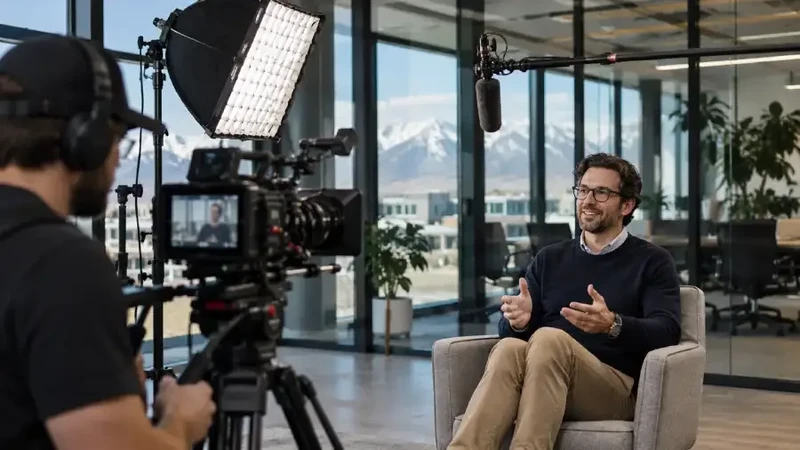
If you work at a software company in Lehi, someone on your team has probably said “we need a better product video” at least twice this year. Maybe it came up after a sales call where the live demo froze. Maybe a competitor launched with a sharp explainer while yours still shows last year’s interface.
Here’s the short answer. Video production in Lehi works best for tech companies when the crew plans for three things most local video guides skip: your product will change after the shoot, your software has to read clearly on camera, and some of what’s on your office walls is confidential. A Salt Lake City production company is about 30 minutes up I-15, so expect strategy and script reviews over video calls, one in-person scout, and two to six weeks from first call to final delivery depending on scope.
Key Takeaways
Tech buyers watch before they talk to sales. Plan each video around its place in your funnel, not around a single shoot day.
Build product videos in modules, so a UI update means swapping a few shots instead of reshooting the whole thing.
Decide early how your software appears on screen: screen recording, rebuilt UI animation, or real monitors filmed live. Each has a different cost and shelf life.
Treat pre-launch shoots like any confidential project: NDAs, a cleared set, and controlled footage storage.
City, county, and state film permits in Utah take at least four business days, so public locations around Lehi need lead time.
Table of Contents
Why Lehi Is a Different Kind of Video Market
In-House Team, Freelancer, or Production Company?
Plan for Your Product Changing Before the Video Gets Old
How Your Software Shows Up on Camera
Confidentiality and Filming Before a Launch
Timing Around Launches, Hiring Seasons, and Winter Light
Filming Inside a Silicon Slopes Office
What Changes When the Crew Comes From Salt Lake City
Questions to Ask Before You Book a Lehi Video Crew
Frequently Asked Questions
Why Lehi Is a Different Kind of Video Market
Lehi sits at the center of Silicon Slopes. Federal housing analysts describe the tech corridor as stretching from Provo to Salt Lake City but concentrated in Lehi (HUD, 2021), and Adobe’s campus near the Point of the Mountain was one of the early anchors that pulled other companies in (CNBC). Walk through the office parks off Thanksgiving Way or Executive Parkway today and nearly every building has a SaaS, fintech, or health-tech logo on it.
That changes what a video has to do. In most cities, a business wants video to introduce itself to customers who have never heard of it. In Lehi, the viewer is usually another business: an operations lead evaluating your platform, an IT team comparing three vendors, or an engineer deciding whether your job post is worth a click. Those people are skeptical and short on time, and they can spot a stock-footage montage in about two seconds.
They also do a lot of their research on video before they ever fill out a form. In Wyzowl’s 2026 State of Video Marketing report, 96% of people said they had watched an explainer video to learn about a product or service, and 93% of video marketers said video had improved how well people understand what they sell (Wyzowl, 2026). For a software product that’s hard to describe in one sentence, that second number is the one to pay attention to.
So a Lehi video usually has a narrow, measurable job: shorten a sales cycle, lift trial-to-paid conversion, or help a recruiter fill senior roles against bigger brands down the street. Our Lehi video production page covers the services side. This post is about what to sort out before you hire anyone.
In-House Team, Freelancer, or Production Company?
Lehi tech companies have more in-house video capability than most Utah businesses. Plenty of marketing teams already have a content creator with a mirrorless camera, a screen-recording setup, and an editing license. That’s a good thing, and it changes the hiring question. You’re rarely choosing between a crew and nothing. You’re deciding which videos your team should make and which ones need outside help.
Here’s the split we see work for most of the tech companies we talk to:
In-house team: feature-update clips, webinar recordings, social posts, quick customer shout-outs. Speed matters more than polish, and whoever edits already knows the product.
Freelance videographer: single-location interviews, event coverage, and testimonial batches where the format is already set.
Production company: the flagship pieces your brand leans on for a year or more, like a launch video, a homepage brand film, a recruiting video, or a customer story your sales team sends to enterprise prospects.
The line between the last two usually comes down to strategy and continuity. A production company starts with what the video needs to accomplish, writes to that goal, and keeps the project files organized so someone can update the video later. That last part matters more for software companies than for almost anyone else, for reasons covered in the next section. If you’re still unsure where your project falls, our breakdown of videographer vs. production company walks through what each one actually delivers.
Plan for Your Product Changing Before the Video Gets Old
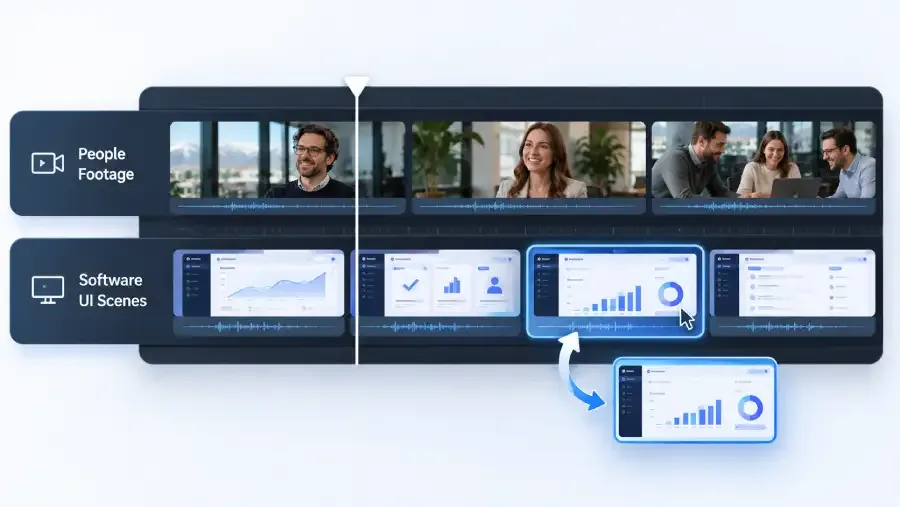
This is the problem that catches most software companies, and it almost never comes up before the shoot.
Your product ships updates every sprint. Your video, once it’s exported, doesn’t. Six months after launch, the dashboard in your explainer has a different navigation bar, the feature named in the voiceover got renamed, and the pricing tier on screen no longer exists. The video still sort of works, but your sales team quietly stops sending it.
You can’t stop the product from changing. You can build the video so that changes are cheap. We call this a modular edit: a video assembled from self-contained scenes, so any one scene can be replaced without re-cutting the rest. In practice that means:
Separate people from pixels. Film the human parts (founders, customers, your team at work) so they stand on their own. Keep software sections in their own scenes.
Keep the voiceover general where the UI is specific. “Your team sees every open ticket in one place” ages far better than “click the new Inbox tab in the left sidebar.”
Leave version-sensitive details off screen. Prices, version numbers, dates, and “new” badges are the first things to go stale.
Get the project files and an archive policy in writing. If the person who edited it leaves, someone needs to be able to open the timeline and swap three shots.
A modular edit costs a little more planning up front. It costs a lot less than a full reshoot when your product team redesigns onboarding next spring.
How Your Software Shows Up on Camera

Every SaaS video eventually has to show the product. There are three common ways to do it, and the choice affects budget, look, and shelf life more than most teams expect.
Screen recordings
The fastest and cheapest option. Recordings are accurate and easy to update, but raw captures can look flat, and small interface text is hard to read on a phone. If you go this route, record at roughly twice your delivery resolution so the editor can push in on details without blur. Use a demo account filled with realistic fake data, and turn off notifications, browser extensions, and anything else that might pop up mid-take.
Rebuilt UI animation
A motion designer recreates key screens as clean graphics. This looks polished, holds up at any size, and lets you simplify a busy interface down to the one action that matters. It also takes longer, and it can drift away from the real product if nobody checks it against current builds.
Live monitors filmed on set
Real people using the real software in a real setting. For operational software, this is the most believable option, because viewers see the product working under pressure. When we produced the product video for LAVU’s restaurant POS system, the whole point was to show the iPad software during an actual service window rather than a clean demo, and that context did more selling than any feature callout could (see our work). The tradeoff is that screen glare, refresh-rate flicker, and readability need careful handling on set.
Most strong product videos combine two of these. A common pattern is live footage of a customer using the product, cut together with a few animated screens that make the key feature readable at a glance. If the video is meant to move deals forward, our post on B2B video marketing covers which formats tend to earn their keep in a sales cycle.
Confidentiality and Filming Before a Launch
Lehi offices are full of things you don’t want on the internet: roadmap whiteboards, unreleased features on a second monitor, customer names on a sales leaderboard. A crew filming wide shots of your workspace will catch all of it unless someone plans around it.
Before a pre-launch or in-office shoot, settle these points:
NDAs signed by everyone on the crew, including any freelancers the production company brings in.
A set sweep the morning of the shoot: whiteboards erased, background monitors switched to approved screens, badges and lanyards checked.
Where the raw footage lives, who can access it, and how long it’s kept. Unreleased product footage shouldn’t sit in a shared folder with a public link.
An embargo date written into the project plan, so nobody posts behind-the-scenes clips before the announcement.
A professional crew expects all of this. If a company seems surprised when you bring up an NDA, that tells you something.
Timing Around Launches, Hiring Seasons, and Winter Light
Most Lehi video projects have a hard date attached: a product launch, a funding announcement, a conference booth, a hiring push. Work backward from it. For a scripted launch video, that usually means a strategy call six to eight weeks out, a locked script about four weeks out, and the shoot two to three weeks before the date so there’s room for revisions. Our guide on how long video production takes breaks down each stage.
Recruiting videos run on their own calendar. If you hire new grads from BYU, UVU, and the University of Utah, a culture or recruiting film does the most work when it’s live before fall recruiting starts, which means shooting in spring or early summer. Our post on employer branding through video covers what makes those films attract the right candidates.
Then there’s the weather. Northern Utah County gets winter inversions that flatten the light and can hide the mountains for days, and short days from December through February leave a small window for exteriors. If your brand film needs the Wasatch behind your building, schedule outdoor shots for spring or fall, or build a weather buffer into a winter shoot.
Filming Inside a Silicon Slopes Office
Lehi office buildings look great on camera and are surprisingly tricky to film in. A few things we plan for on almost every tech-office shoot:
Glass everywhere. Glass walls and conference rooms reflect lights and crew, so we choose angles and room positions during the scout, not on the day.
Open floor plans are loud. Book an interview room with a door for the full day, and ask facilities whether the HVAC can be paused during takes.
Phone booths are too small. They look cozy on an office tour but rarely fit a camera, two lights, and a subject at a flattering distance.
Hybrid schedules decide who shows up. If you want the office to look busy in B-roll, shoot on your team’s in-office days and give people notice that a crew is coming.
Check your brand walls. Worn vinyl, outdated logos, and old taglines show up in a frame faster than you’d think.
What Changes When the Crew Comes From Salt Lake City
Lehi is about 30 minutes from downtown Salt Lake City when I-15 is clear, and longer when traffic stacks up at the Point of the Mountain. A crew that respects that drive arrives early enough to light the room and test audio before your first interview. For a 9:00 a.m. start, that usually means leaving Salt Lake around 7:30.
Most of the work happens remotely anyway. Strategy calls, script reviews, and edit feedback all run over video calls and timestamped review links. The in-person parts are one scout and the shoot itself. Because it’s a short drive, a missing shot found during the edit means a quick return trip, not a rebooking problem. Eagle Wing quotes Lehi shoots as local work, with no out-of-state travel fees.
If any part of the shoot moves off your property, permits come into play. According to the Utah Film Commission, city, county, and state film permits in Utah take a minimum of four business days to process and sometimes 10 to 15 (Utah Film Commission). Popular private venues around Lehi, like Thanksgiving Point, run their own booking process, so check availability early too.
Questions to Ask Before You Book a Lehi Video Crew
Portfolio and price are the obvious questions. These are the ones that separate crews that work well with tech companies from crews that don’t:
How do you plan product videos so they can be updated when our UI changes?
Have you filmed software on screen, and how did you handle readability and glare?
Will you sign our NDA, and how do you store unreleased footage?
Who owns the raw footage and project files, and how long do you keep them?
Can you deliver cutdowns for our website, LinkedIn, sales emails, and vertical social from the same shoot?
None of these are trick questions. A crew that has worked with software companies will answer all five without hesitating.
Frequently Asked Questions
How much does video production cost in Lehi?
Most Lehi business videos range from about $1,500 for a simple single-location interview to $15,000 or more for a scripted launch video with several locations and motion graphics. Crew size, the number of shoot days, and how much UI animation the edit needs move the price the most. For detailed ranges, see our Utah corporate video pricing breakdown.
How long does it take to make a SaaS product video?
A focused product or explainer video usually takes two to four weeks from the strategy call to delivery. Launch videos with scripting, talent, and custom animation run closer to four to eight weeks. If you have a fixed launch date, share it on the first call so the schedule can be built backward from it.
Should we use screen recordings or animation in our product video?
Use screen recordings when accuracy and easy updates matter most, and animation when the interface is busy and you need to highlight one action clearly. Many teams combine both with live footage of real users. The right mix depends on how complex the product is and where the video will run.
Can a crew film inside our office without disrupting the team?
Yes, with some planning. Most shoots need one interview room for the day and short windows in common areas for B-roll. Giving the team notice and scheduling around in-office days keeps the disruption small.
Do Salt Lake City production companies charge travel fees for Lehi shoots?
Some do, so ask when you compare quotes. Lehi is roughly 30 minutes from Salt Lake City, and most Utah-based crews treat it as local work. Eagle Wing quotes Lehi shoots without out-of-state travel fees.
Ready to Plan Your Lehi Shoot?
The Lehi tech videos that hold up are the ones built for how software companies actually work: products that keep changing, buyers who research before they talk, and teams that guard their roadmap. Eagle Wing Productions is based in Salt Lake City and works with Utah County companies on product demos and customer stories, recruiting and brand films, and launch videos. See our video production services in Lehi, or book a free strategy call and we’ll tell you honestly which pieces your team can make in-house and which ones are worth hiring out.
Start Your Project
Ready to Bring Your Story to Video?
Book a free strategy call, and we'll help you figure out which type of video will deliver the best ROI for your business.