B2B Video Marketing: What Actually Moves Deals Forward
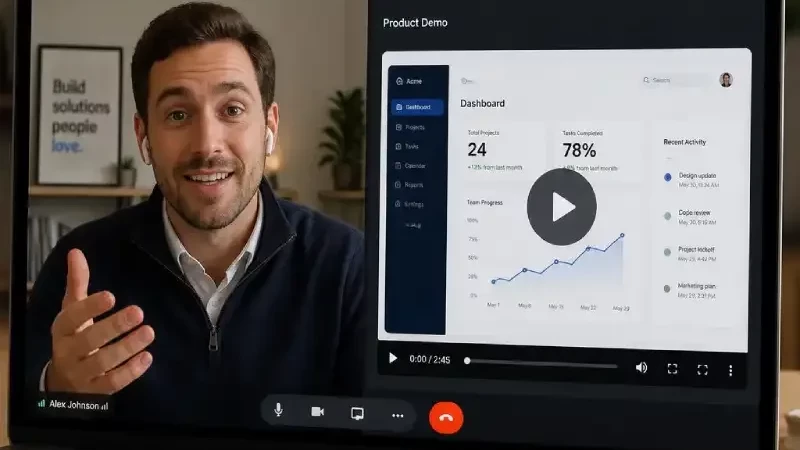
Most B2B companies already believe in video. Fewer can point to a specific deal it helped close. The gap between those two facts is usually a strategy problem, not a production problem: the video gets built around a brand message instead of a buying-stage question, gets uploaded once, and gets forgotten by everyone except the marketing team that made it. B2B video marketing only moves deals forward when it is built to answer the exact question a prospect is asking at the exact stage they are asking it, which means the strategy has to start with the sales cycle, not the camera.
What Counts as B2B Video Marketing, and What Doesn’t
B2B video marketing covers any video built to move a business buyer through a considered, multi-stakeholder purchase decision, from a short brand piece a prospect sees before ever talking to sales, to a product demo a rep sends after a discovery call. What it is not is a shorter version of B2C advertising. A consumer ad has one viewer making an individual, often impulsive decision. A B2B video usually has to hold up under scrutiny from a buying committee, get forwarded internally without the marketer in the room to explain it, and survive being watched by someone who has already seen three competitors’ versions of the same pitch.
That distinction is why runtime, tone, and distribution all differ. B2B marketing video tends to run longer than a consumer spot, lives behind a sales conversation or gated content rather than in a public feed, and speaks to a specific role or objection instead of a broad audience. Video built without that distinction in mind tends to look and perform like an ad that wandered into the wrong sales cycle.
Where Video Actually Moves a B2B Deal Forward
Awareness-stage video builds recognition but rarely gets credited with closing anything, and that is fine, because it is not supposed to. The stage where video shows up most clearly in pipeline data is consideration and decision, when a prospect is comparing two or three vendors and needs proof rather than more messaging. A well-placed customer story video at this stage does something a case study PDF cannot: it lets a skeptical buyer see and hear another customer describe the exact outcome they are hoping for, in that customer’s own words. That kind of proof is difficult to fake and easy for a buying committee to trust. Companies serious about this stage of the funnel invest in video marketing built specifically around the objections a sales team hears in live deals, not around general brand positioning.
Decision-stage video works even harder when it is built for a rep to use directly, rather than for a prospect to stumble across. A product demo sent as a follow-up after a discovery call, timed to answer the specific question that came up in that call, tends to move a deal forward more reliably than the same video sitting on a website waiting to be found.
The Video Formats That Do the Heavy Lifting in Sales Enablement
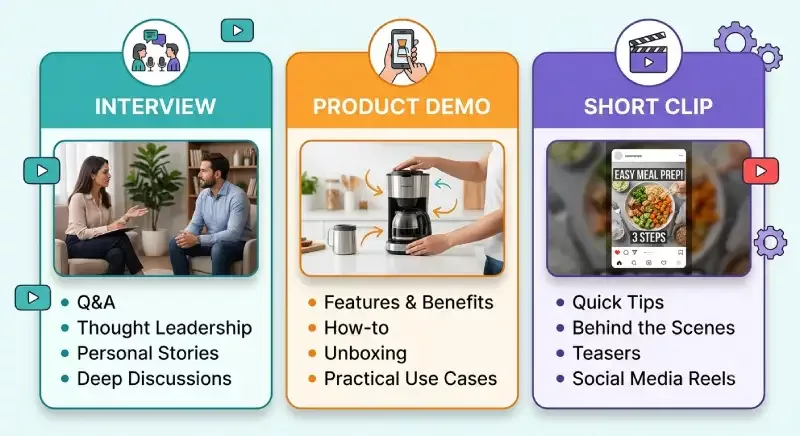
Three formats consistently show up in B2B video strategies that actually influence pipeline, each doing a different job.
Customer story videos: real customers describing a real outcome in their own words, used at the consideration stage to build trust a case study alone can’t.
Product or process demos: short, specific walkthroughs a sales rep can send after a call to answer exactly what was asked, not a generic feature tour.
Objection-response clips: two-minute videos built around the single objection a sales team hears most often, so a rep can send one instead of retyping the same explanation in every email.
Notice that none of these is a polished, standalone brand film. That format still has a place in a broader marketing plan, but it is rarely the piece that shows up in a closed-won deal’s history.
Why Most B2B Marketing Video Falls Flat
The most common failure pattern is building one video and expecting it to work at every funnel stage at once. A single three-minute brand story gets used as the awareness piece, the consideration piece, and the sales enablement tool, and it underperforms at all three jobs because it was built for none of them specifically. The second most common failure is building the video without sales in the room. Marketing knows the brand message. Sales knows which objection actually stalls a deal in week three of a live evaluation, and a video built without that input tends to answer questions prospects were never actually asking.
The fix is not more video, it is more specific video. A company that replaces one generic brand film with three short, funnel-stage-specific pieces usually sees the difference in whether sales reps actually use the content, since a rep will send a two-minute answer to a live objection far more often than they will send a polished but generic brand piece.
How Video Priorities Should Shift With Deal Size
A B2B video strategy built for a company selling a five-figure annual contract looks different from one built for a company closing seven-figure enterprise deals, even if both are technically "B2B." Smaller, higher-volume deals tend to benefit most from scalable, reusable video: a strong product demo and a couple of short objection-response clips that a sales team can send to dozens of prospects without customization. The video does more of the persuading because there is less time for a rep to build a fully custom relationship with every prospect.
Larger, longer-cycle enterprise deals shift the priority toward depth over scale. A single, highly specific customer story video, one that matches the exact industry and use case of a target account, often outperforms a library of generic clips, because a buying committee evaluating a seven-figure decision is looking for proof that closely mirrors their own situation, not just proof that the product works in general. Companies that get this backwards, building broad brand content for enterprise deals or expensive custom pieces for high-volume transactional sales, tend to see weak returns regardless of production quality.
Building a B2B Video Content Strategy That Doesn’t Stall After One Video
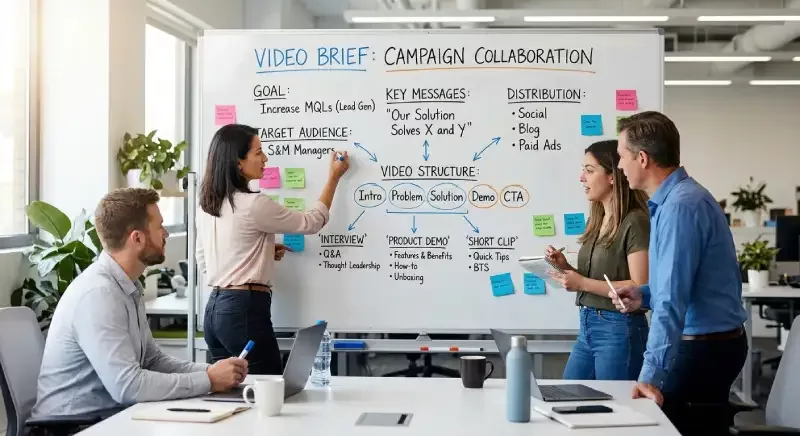
A strategy that survives past the first project starts with a short list, built jointly with sales, of the three or four questions or objections that show up in nearly every deal. Each of those becomes a video brief before a single day is spent on production planning. From there, distribution gets decided up front: which pieces live on the website for organic discovery, which get built specifically to be sent by a rep, and which support paid or account-based campaigns aimed at a named list of target accounts.
Measurement has to move with the strategy too. Watch-through rate and view count are easy numbers to report but weak signals for B2B, where the real question is whether deals that included a specific video moved through the pipeline faster than deals that didn’t. Tying video performance to CRM stage changes, even roughly, tells a marketing team far more than a view count ever will.
How Eagle Wing Builds B2B Video Marketing That Sales Teams Actually Use
Our video marketing engagements start with the same question we’d ask any sales team directly: what objection or question comes up in nearly every deal you’re currently working. That conversation shapes the video brief before a shot list ever gets built, so the finished piece answers something a real prospect is actually asking rather than restating a brand pitch a sales rep has already given in the room.
For companies that need the full range, from a top-of-funnel brand piece through the corporate video work that supports internal training, recruiting, and process documentation, we plan the whole set together so each piece has a distinct job instead of competing for the same funnel stage. If you already know which objection is stalling your deals, that’s usually the best starting point for a conversation with us, not the brand video most companies default to first.
Everything You Need to Know About B2B Video Marketing
What is the difference between B2B video marketing and B2B sales enablement video?+
B2B video marketing generally targets prospects earlier in the funnel to build awareness and demand, while sales enablement video is built for a rep to use inside an active deal, answering a specific objection or explaining a specific capability a prospect asked about. Many B2B companies need both, built with different goals in mind.
How long should a B2B marketing video be?+
Top-of-funnel B2B marketing video generally performs best under two minutes, since awareness-stage viewers have not yet committed to the topic. Sales enablement video used inside an active deal can run longer, often three to six minutes, because the viewer has already opted in by requesting or receiving it.
Does B2B video marketing actually influence pipeline, or just awareness?+
Yes, when the video is built around a specific buying-stage question rather than general brand messaging. Video built to answer the objections a sales team actually hears in live deals correlates with pipeline movement far more reliably than a generic brand awareness video, which mainly influences top-of-funnel recall.
Who should be involved in building a B2B video content strategy?+
Sales should be involved from the start, not just marketing. The sales team knows which objections actually stall deals and which questions come up on every discovery call, and that input is what keeps the video content strategy tied to real deal movement instead of guesswork.
How do you measure whether a B2B marketing video is working?+
Watch-through rate and view count matter less for B2B than whether sales reps are actually using the video inside live deals and whether deals that included the video move through the pipeline faster than deals that did not. Tie video performance to CRM data, not just view metrics from the hosting platform.
Start Your Project
Ready to Bring Your Story to Video?
Book a free strategy call, and we'll help you figure out which type of video will deliver the best ROI for your business.