
Employer Branding Through Video: Why Company Culture Films Convert Better Candidates

Most careers pages look the same. A smiling team, a rooftop, a line about everyone being family. Candidates have seen it a hundred times, so the video mostly adds to the applicant pile.
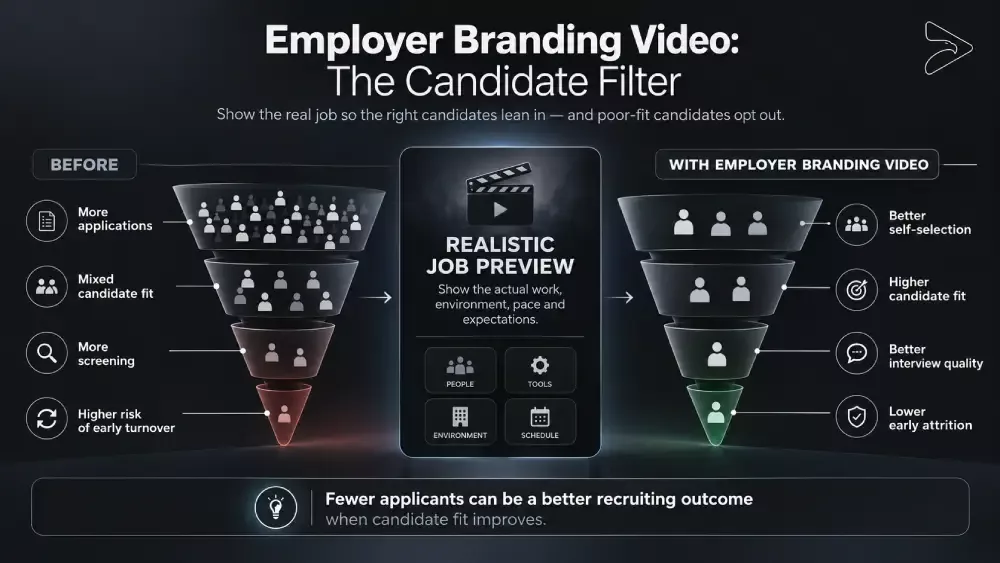
An employer branding video is a short film that shows what it is actually like to work at a company, told by the people who work there. Done well, it does something a job post cannot: it helps the wrong candidates decide not to apply and the right ones decide they want this job in particular. That is the real case for a company culture video. A better-matched pipeline is worth more than a bigger one.
This post covers why that works, what to film so the video filters instead of flatters, how to get a full year of content out of one shoot, and how to tell afterward whether candidate quality actually improved.
What Is an Employer Branding Video?
An employer branding video is a short film that shows a company's culture, values, and day-to-day work through the people who do it, with the goal of attracting and keeping the right employees. It usually lives on a careers page, in job posts, on LinkedIn, and in the emails candidates get before an interview.
It is not quite the same as a recruitment video. A recruitment video is tied to an opening: this role, this team, apply by Friday. An employer branding video is evergreen and speaks about the company as a workplace. A talent attraction video sits in between, usually a piece aimed at one family of roles, such as nurses or field technicians. Most companies need the evergreen film first and the role-specific cuts second. If you are working on the role-specific end, our post on recruitment videos covers that side in more detail.
HR teams often budget this as an hr marketing video, which is fine, but the audience is split. Candidates watch it to decide whether to apply. Current employees watch it to see whether the company describes their job honestly.
Why Culture Films Bring In Better Candidates, Not Just More

The usual pitch for employer branding video is reach: more views, more applicants, more awareness. Reach matters, but it is the weakest argument for the format. A film that doubles your applications and fills the pipeline with people who leave in four months has made recruiting harder, not easier.
The stronger argument is self-selection. When candidates can see the actual environment, including the pace, the noise, the tools, the hours, and what people there talk about, they make a more informed decision before they apply. Some decide it is not for them. That is a good outcome.
Organizational psychologists call this a realistic job preview. In a meta-analysis of 40 studies published in the Academy of Management Journal, Jean Phillips found that realistic job previews were related to lower attrition from the recruitment process, lower initial expectations, lower voluntary turnover, and higher job performance. She also found that the timing and medium of a preview affected how well it worked, so the format has to match the outcome you care about.
That study covers previews in general, not video specifically. Treat it as the reason the approach works, not proof that video beats every other format. Video is simply an inexpensive way to give every candidate the same realistic preview before the first conversation.
There is a cost side as well. LinkedIn's employer branding guide says a strong employer brand can reduce recruiting costs by up to 43%. That figure describes employer brand as a whole, not video alone, but a film is one of the most direct ways to show that brand instead of describing it.
What to Film If You Want the Video to Filter
Most culture videos flatter. They show the best day, the best office, and the best angle. A filtering film shows an ordinary Tuesday. Five choices make the difference.
Show the hard parts. If the job involves early starts, a loud floor, or on-call weeks, have someone say so on camera and explain why they stay anyway. Candidates who hear that and still apply are the ones likely to stick around.
Use specifics. "We have a great team" tells a candidate nothing. "We stand up at 7:15 and whoever is closing the dock walks us through the day" tells them a lot. Ask for details about tools, meetings, schedules, and what a good week looks like.
Put employees first and leadership second. Candidates discount executives talking about culture, because executives are expected to. Start with people in the roles you are hiring for. A short message from a leader can open or close the film, but it should not carry it.
Write questions, not lines. Interview people in their own workspace. Ask about a hard week, a mistake they learned from, and the moment they decided to stay. Then use what they actually said, including the pauses. Stiff scripted delivery is the fastest way to lose a viewer who has watched other careers videos.
Include a "this is not for you if" moment. It feels risky, and it is the most useful forty seconds in the film. One employee saying that people who need constant direction will struggle here saves both sides a wasted interview.
Four Formats That Hold Up

One long video is hard to reuse, and one short clip cannot carry a whole workplace. In practice, four formats cover most needs, and all four can come from the same shoot.
The hero film, usually two to three minutes, carries several voices and lives at the top of the careers page. The day in the life, roughly 60 to 90 seconds, follows one person in one role from arrival to wrap. The employee journey story is a longer piece about one person's path through the company, which helps with recruiting and also with how current staff see their own futures. Our post on employee journey mini-docs explains how those are built. Finally, role clips of 15 to 45 seconds, framed vertically, answer one question each and work well in job posts and LinkedIn.
These lengths are typical ranges, not rules. A company with a dozen distinct job families may need more clips and a shorter hero film. Our guide to corporate culture videos covers the wider set of culture formats, including values and milestone pieces, if you want to see what else is possible.
Plan One Shoot That Produces a Year of Content
Capturing for all four formats in a single day is mostly a planning job. The footage is cheap once the crew is on site. Missing footage is expensive, because it means another shoot.
Start with the employee value proposition, meaning what you offer and what you require in return. It decides what to ask and what to leave out. Then pick six to ten people across roles, tenure, and locations, including someone who joined recently and someone who has stayed a long time. Write one question bank and one shot list that cover every format at once: horizontal frames for the hero film, vertical frames for clips, and real footage of the work itself, not conference rooms. Collect releases before the day, schedule around operations, and plan captions so every cut works without sound.
A starter question bank keeps the interviews specific. These six work across most industries:
Walk me through a normal day from the moment you arrive.
What surprised you most in your first three months?
Tell me about a hard week and what got you through it.
What is the part of this job people outside the company never see?
Who does well here, and who tends to struggle?
When did you decide you were staying?
Let people opt out. Anyone uncomfortable on camera should be able to say no without any consequence, because a reluctant interviewee shows in the footage and sends the wrong signal about the culture. It is better to film four willing people than eight who were volunteered by their managers.
This is where an experienced crew earns its fee. Our corporate video production process starts with a discovery and creative brief, and that brief is where the filtering strategy gets decided, before anyone picks up a camera.
Where to Publish It
A strong film hidden on a video host that nobody visits helps no one. Put the hero film near the top of the careers page and embed the matching role clip in each job post. Share cutdowns on LinkedIn and ask employees to post them. Send the film to candidates in the confirmation email before the first interview, so the conversation starts from a shared picture. Use it again in onboarding, where it doubles as a check on whether the first week matches the promise.
Distribution is a video marketing question as much as a production one. Cutdowns, captions, and posting cadence decide whether the film gets seen, and our video marketing team plans that alongside the shoot.
How to Measure Whether Candidate Quality Improved
Views tell you the film was seen. They do not tell you whether it worked. Record a baseline before launch, then track what changes on the roles the film supports:
Application-to-interview rate: if it rises, more of your applicants are a fit.
Offer acceptance rate: candidates who know the job rarely get surprised at the offer stage.
Early attrition: compare 90-day and six-month departures before and after.
New hire feedback: LinkedIn suggests surveying new hires a few months in and asking whether expectations matched reality and which parts were misrepresented. That same question tells you whether your film is honest.
Expect total applications to stay flat or even fall on the roles the film targets. If interviews per application go up while early departures go down, the film is doing its job.
Mistakes That Make a Culture Film Backfire
Stock footage and hired actors are obvious within seconds and cost you the trust the film exists to build. Over-promising is worse: the film sets an expectation the job then has to meet, and a new hire who feels misled will say so on review sites. If new hires keep telling you the job is not what the film showed, fix the job or fix the film. Finally, a film that shows a leadership team or office that no longer exists is a liability, so update it when the workplace changes in a way a candidate would notice.
Employer Branding Video FAQ
What is an employer branding video?+
An employer branding video is a short film that shows a company's culture, values, and daily work through its employees to attract and keep the right talent. It typically appears on careers pages, job posts, and social channels.
What is the difference between an employer branding video and a recruitment video?+
An employer branding video is evergreen and describes the company as a workplace. A recruitment video is tied to a specific opening and usually ends with a deadline or a call to apply. Many companies build the evergreen film first and cut role-specific recruitment clips from the same footage.
How do you do employer branding with video?+
Start with your employee value proposition, choose six to ten real employees across roles, interview them on location without scripts, and cut the footage into a hero film, a day in the life, and short role clips. Publish them on your careers page, in job posts, and on LinkedIn, then track interview rate, offer acceptance, and early retention.
How long should an employer branding video be?+
A hero film usually runs two to three minutes. A day in the life runs about 60 to 90 seconds, and role clips for job posts and social run 15 to 45 seconds. Shorter is better for reach, but each piece should be long enough to include one specific, honest detail.
How do you measure the success of an employer branding video?+
Measure candidate quality, not just views. Compare application-to-interview rate, offer acceptance, and 90-day attrition before and after launch, and survey new hires on whether the job matched what they saw. A drop in raw applications is acceptable if the fit of the people who apply improves.
Planning an Employer Branding Video?+
If you want the brief to start from candidate quality instead of view counts, Eagle Wing Productions can scope a culture film with you and plan the cutdowns before the shoot day, whether your team is in Salt Lake City or elsewhere in Utah. You can also browse more of our video production guides on the blog.
Start Your Project
Ready to Bring Your Story to Video?
Book a free strategy call, and we'll help you figure out which type of video will deliver the best ROI for your business.