
Hiring a Provo Videographer: What to Expect From a Salt Lake City Crew
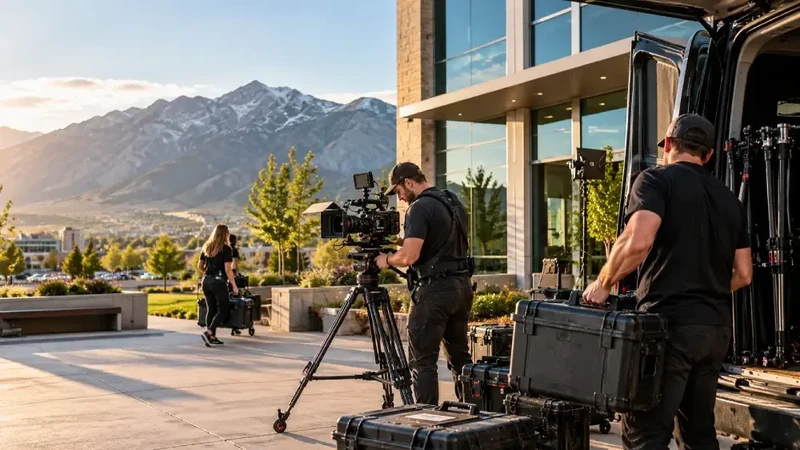
If you run a business in Provo and need a video made, you have more choices than most Utah cities give you. BYU and UVU both run film and digital media programs, so the town is full of freelance Provo videographers with a camera and a reel. Full production companies sit about 45 minutes up I-15 in Salt Lake City, and the good ones drive down for Utah County shoots all the time.
So who should you hire? A solo videographer is the right call for quick, single-location content like a testimonial or a social clip. A production crew earns its fee once the project has a script, more than one location, or a lot riding on how it looks. If you book a Salt Lake City crew, expect a strategy call before any quote, one in-person scout, a shoot day planned around the drive, and roughly two to six weeks from first call to final delivery depending on scope.
Key Takeaways
Provo has a deep freelance pool thanks to BYU and UVU, which is great for small jobs and riskier for projects that need the same person around for revisions months later.
A Salt Lake City crew is about 45 minutes from downtown Provo, so a good one plans call times and bundles deliverables around that drive.
Most of the work happens remotely: strategy, scripting, and review. Expect one scout trip and the shoot itself in person.
City, county, and state film permits in Utah take at least four business days to process, and federal land like Provo Canyon takes at least 15.
Know whether you need a commercial (paid ad) or a corporate video (recruiting, culture, brand story) before you ask for a quote.
Table of contents
Who You Can Hire for Video in Provo, and When Each One Makes Sense
What Changes When Your Crew Drives Down From Salt Lake City
How a Provo Video Project Runs, From First Call to Final Cut
Planning Around Provo's Calendar, Light, and Permit Lead Times
What Your Team Should Have Ready Before Shoot Day
Provo Commercial Video or Corporate Video: Which One Are You Asking For?
Questions to Ask a Provo Videographer Before You Book
Frequently Asked Questions
Ready to Plan Your Provo Shoot?
Who You Can Hire for Video in Provo, and When Each One Makes Sense
Provo is an unusual video market. Most cities its size have a handful of videographers and maybe one production shop. Provo has a long list of people who can shoot and edit, because two universities keep training new ones. That's good news for your budget, and it also means you need to be clear about which kind of help you're actually hiring.
There are roughly three tiers, and they aren't ranked by quality so much as by what they're built to handle:
Student or recent-grad freelancers. Often talented, usually affordable, and a solid fit for event coverage, simple interviews, or a batch of social clips. The catch is availability. Their schedules follow the academic calendar, and many leave Utah County after graduation, so the person who shot your video in March may not be around to recut it in October.
Established solo videographers. One person, sometimes with an assistant, who shoots, records audio, and edits. A good match for a single testimonial, a short leadership message, or a product clip filmed in one place.
Production companies. A producer, a director, a camera team, an editor, and a process that starts with strategy before anyone touches a camera. This is what you want for a scripted brand film, a commercial with talent and multiple locations, or a recruiting video your company will lean on for two years.
Plenty of Provo businesses use more than one tier, and that's normal. Wyzowl's 2026 State of Video Marketing report found that 42% of businesses rely on external video creators in some capacity, with most of those mixing outside help with in-house content (Wyzowl, 2026). A common split we see: an in-house marketer or freelancer handles weekly social content, and a production company handles the two or three pieces a year that have to carry the brand.
If you're still sorting out the difference, our breakdown of videographer vs. production company walks through what each one actually delivers.
What Changes When Your Crew Drives Down From Salt Lake City
Hiring a Salt Lake City crew for a Provo shoot isn't like hiring from out of state. Nobody books a flight or a hotel. It is a 45-minute drive, though, and closer to an hour when traffic backs up through the Point of the Mountain. A crew that plans for that drive gives you a better day. One that ignores it shows up late and rushed.
Here's how the drive should shape the plan:
Call times work backward. If you want interviews rolling at 9:00 a.m., the crew needs to arrive around 7:45 to unload, light the room, and test audio. That means leaving Salt Lake around 7:00. Ask the crew what time they'll arrive, not just what time they'll start.
Full days usually beat half days. The drive costs the same whether the crew shoots for three hours or eight. Bundling the work into one trip (interviews in the morning, B-roll around the building after lunch, a few vertical clips for social at the end) gets you more footage per dollar.
Pickups are a drive, not a project. If the edit reveals a missing shot, a local crew can come back down I-15 the same week. An out-of-state crew has to rebook everything.
Ask how travel shows up on the quote. Some Salt Lake companies add mileage for Utah County. Eagle Wing quotes Provo shoots as local work, without out-of-state travel fees, but it's a fair question to ask anyone you're comparing.
The other thing the drive changes is how often you meet in person. For most Provo projects we hold the strategy call and script reviews over video, then make one in-person trip to scout the location. That keeps your team's time free and saves the in-person visit for the stuff a screen can't show, like how loud the HVAC is in your conference room or where afternoon sun hits the lobby.
How a Provo Video Project Runs, From First Call to Final Cut
The process doesn't change much by city, but the split between remote and in-person work does. Here's what a typical Provo project looks like when the crew is based in Salt Lake:
Strategy call (remote). We start with what the video needs to accomplish: a hire, a lead, a sale, a launch. Budget and format come after that answer, not before.
Script and plan (remote). A script or interview outline, a shot list, and a schedule. You review these in a shared document and sign off before anything gets booked.
Location scout (in person). One visit, usually a week or two before the shoot. We check light, sound, power, parking, and anything that could slow the day down.
Shoot day (in person). The crew arrives early, sets up, and works through the shot list with one point of contact from your team.
Edit and review (remote). You get an online review link where you can leave comments at specific timestamps. Most projects include one to two rounds of revisions.
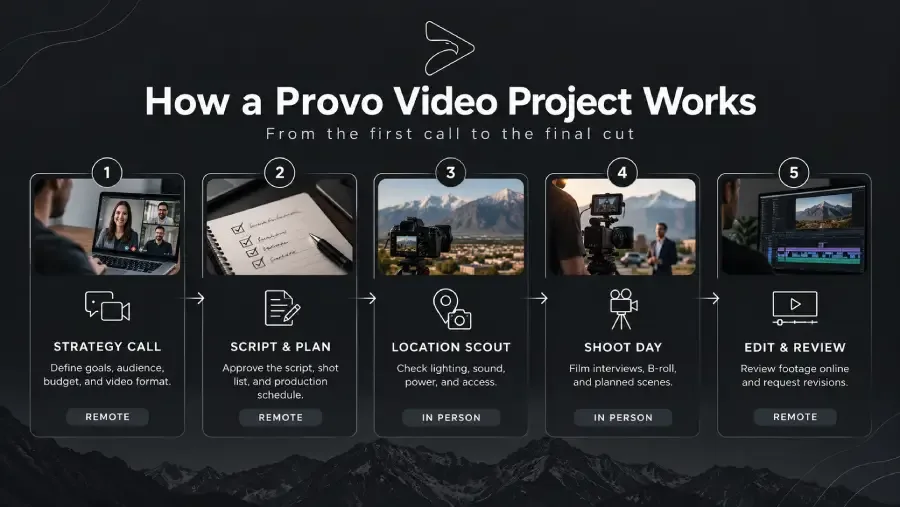
A simple interview piece can move through all five steps in two to three weeks. A scripted commercial with casting and several locations usually takes four to eight. Most delays happen before the shoot, in scheduling and approvals, not in the edit. Our guide on how long video production takes covers each stage in more detail.
Planning Around Provo's Calendar, Light, and Permit Lead Times
This is the part most hiring guides skip, and it's where a Provo shoot can quietly go sideways. Three things are worth putting on your calendar early.
The university calendar
Provo runs on BYU and UVU time more than most businesses notice until they try to schedule around it. Traffic and parking near campus change sharply at the start and end of each semester and on graduation weekends. BYU home football Saturdays fill University Avenue and the streets around LaVell Edwards Stadium, so we avoid scheduling exterior shots nearby on game days.
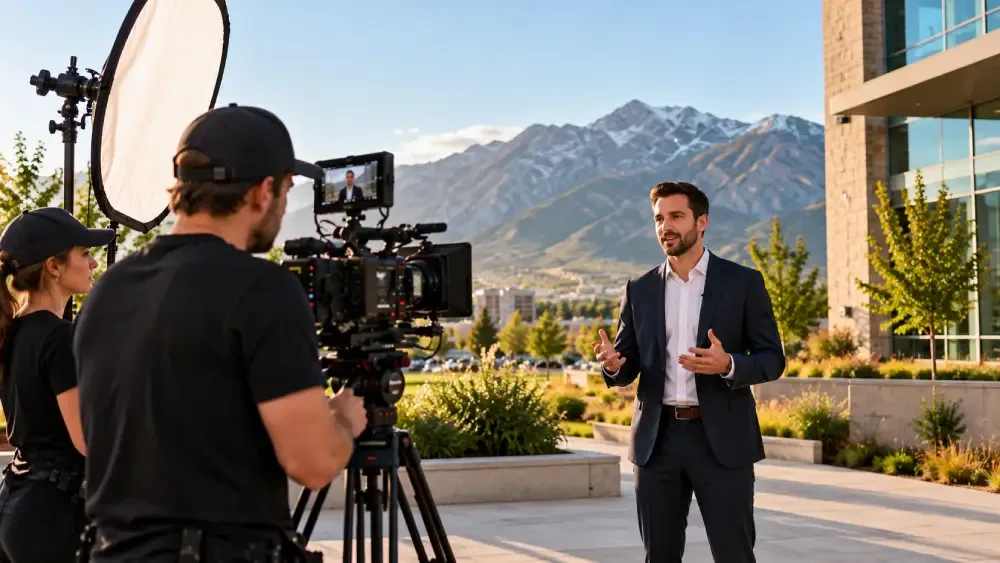
The calendar matters for content too. If you recruit from BYU and UVU, a recruiting or culture video does the most work when it's live before fall hiring season starts. Working backward, that means shooting in late spring or summer, which is also when freelance student crews are hardest to book.
Light and weather
Utah Valley gets winter inversions, the hazy layer of cold air that can hide the Wasatch behind a gray wall for days at a time. If your video needs mountains in the background, plan exteriors with a weather buffer from December through February, or move the outdoor work to spring and fall. Summer has the opposite problem: midday sun is harsh, and golden hour lands late in the evening. A crew that knows the valley will schedule interviews indoors at midday and save exteriors for the edges of the day.
Permit lead times
Shooting on your own property only needs your permission. Public locations are different. According to the Utah Film Commission, city, county, and state film permits in Utah take a minimum of four business days and sometimes 10 to 15, and federally managed land usually requires at least 15 business days (Utah Film Commission). The same source puts most city and county permit fees at around $50 to $250 per day. If your video includes Provo Canyon or another spot on Forest Service land, that lead time can set your shoot date.
Provo also has a few location rules that catch businesses off guard, including limits on commercial filming at BYU and drone restrictions near the airport. We cover those on our Provo video production page, so you can check them before anything lands in a storyboard.
What Your Team Should Have Ready Before Shoot Day
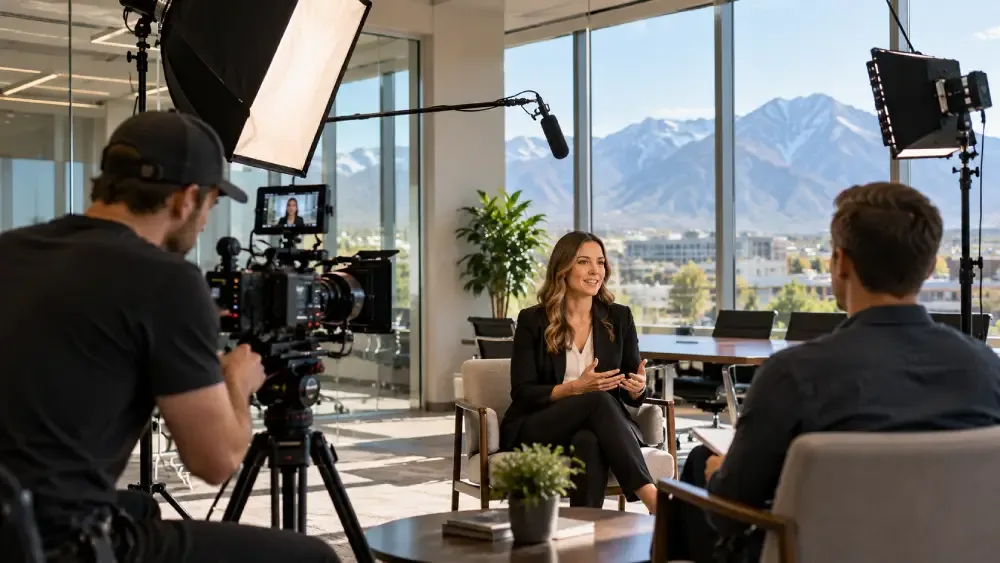
Plenty of Provo companies work out of open-plan offices, especially in tech and direct sales. They look great on camera and are terrible for recording audio. A little prep on your side makes a bigger difference to the final video than any piece of gear the crew brings.
One decision maker on set. Someone who can approve a change on the spot without waiting on a Slack thread.
A room with a door for interviews. Book it for the whole day, and ask facilities whether the HVAC can be paused during takes.
Signed releases from every employee or customer who will appear on camera, collected before the shoot.
Parking and access for a crew vehicle with gear, plus badges or a door code if your building is locked.
Prepped interview subjects. Share the topics a few days ahead, not a script. People sound more natural when they know the questions but haven't memorized answers.
Brand assets like logo files, fonts, and color codes, so post-production doesn't stall waiting on them.
A 20-minute walkthrough call a few days before the shoot covers all of this. It's the cheapest step in the whole project, and it prevents most of the delays that end up on an invoice.
Provo Commercial Video or Corporate Video: Which One Are You Asking For?
Half the confusion in a first call comes from the words. "Commercial" and "corporate video" get used interchangeably, but they're built for different jobs, and the difference changes the script, the crew, and the price.
A commercial is a video built to run as a paid ad on TV, streaming, YouTube, or social. It's short, it has a single message, and it's designed to make a stranger do something. Provo has a lot of consumer and direct-sales brands that sell well outside Utah County, and for them a Provo commercial video is often the main way new customers meet the brand. Our commercial video production work covers that full process, from concept and casting to cutdowns for each platform.
A corporate video represents the company itself: a brand story, a culture film, a recruiting video, a leadership message. For Provo employers competing for the same graduates, this is usually the higher-value piece. Candidates watch these before they apply, and a video that shows real people doing real work gives them a reason to pick you. That's the core of our corporate video production service.
Quality matters for both. In the same Wyzowl report, 89% of consumers said video quality affects how much they trust a brand (Wyzowl, 2026). That doesn't mean every video needs a full crew. It means the ones carrying your reputation probably do.
Questions to Ask a Provo Videographer Before You Book
Most hiring checklists cover portfolio and price. These are the questions that matter more in a college town where a lot of the talent is early in their career:
Who owns the raw footage, and how long will you keep it archived?
Will you be available for revisions or a recut six months from now?
Are you insured to film inside our building?
How do you handle mileage, parking, and a return trip if we need a pickup shot?
Can I see a project you shot in Utah County, and talk to that client?
None of these are trick questions. A professional crew will answer all five without hesitating. For a longer list, see our 10 must-ask questions when hiring a videographer.
Frequently Asked Questions
How much does it cost to hire a videographer in Provo?+
It depends on crew size, number of locations, and how much scripting and editing the project needs. A single-location interview with a solo videographer sits at the low end, and a scripted commercial with talent and several locations sits at the high end. For real ranges, see our Utah corporate video pricing breakdown, and ask any crew you're comparing for an itemized quote.
Do Salt Lake City video companies charge travel fees for Provo shoots?+
Some do and some don't, so ask before you compare quotes. Provo is about 45 minutes from Salt Lake City, which most Utah-based crews treat as local work. Eagle Wing quotes Utah County shoots without out-of-state travel fees, and a return trip for a pickup shot is a normal drive.
Should I hire a BYU or UVU student to make my business video?+
A student can be a great choice for simple, single-location content on a tight budget. The risk is continuity, since students graduate, move, and get busy during finals. For a scripted video, a recruiting film, or anything you'll need recut later, a production company with a stable team is the safer bet.
How far in advance should I book a video crew in Utah County?+
Plan on booking three to six weeks ahead for most projects, and earlier if you need public locations. City and state permits in Utah take at least four business days, and federal land takes at least 15. Late spring and early fall fill up fastest because the light and weather are easiest to work with.
Can we film our business video on the BYU campus?+
Generally no. BYU restricts commercial and promotional filming on campus property, so a brand video can't use its buildings or grounds as a backdrop. A crew that knows Provo can find the same college-town look downtown or at a private venue.
Ready to Plan Your Provo Shoot?
Hiring a Provo videographer comes down to matching the crew to the job: a freelancer for quick content, a production team for the videos that have to carry your brand. Eagle Wing Productions is based in Salt Lake City and works with Utah County businesses on everything from a single testimonial to a multi-location commercial. See our video production services in Provo, or book a free strategy call and we'll tell you honestly which kind of crew your project needs.
Start Your Project
Ready to Bring Your Story to Video?
Book a free strategy call, and we'll help you figure out which type of video will deliver the best ROI for your business.