How Long Does Video Production Take? A Realistic Timeline
Ask five video production companies how long a project takes and you will get five different numbers, mostly because the question is really three questions stacked on top of each other. Most professional video production runs three to eight weeks from the first planning call to final delivery, and the part most people picture when they ask the question, the actual filming, is usually the shortest piece of that timeline: one to five days for a typical business video. If you are asking how long it takes to shoot a film specifically, meaning a feature-length movie, that is a different production model entirely, and we will break down both below.
The Three Stages of a Video Production Timeline
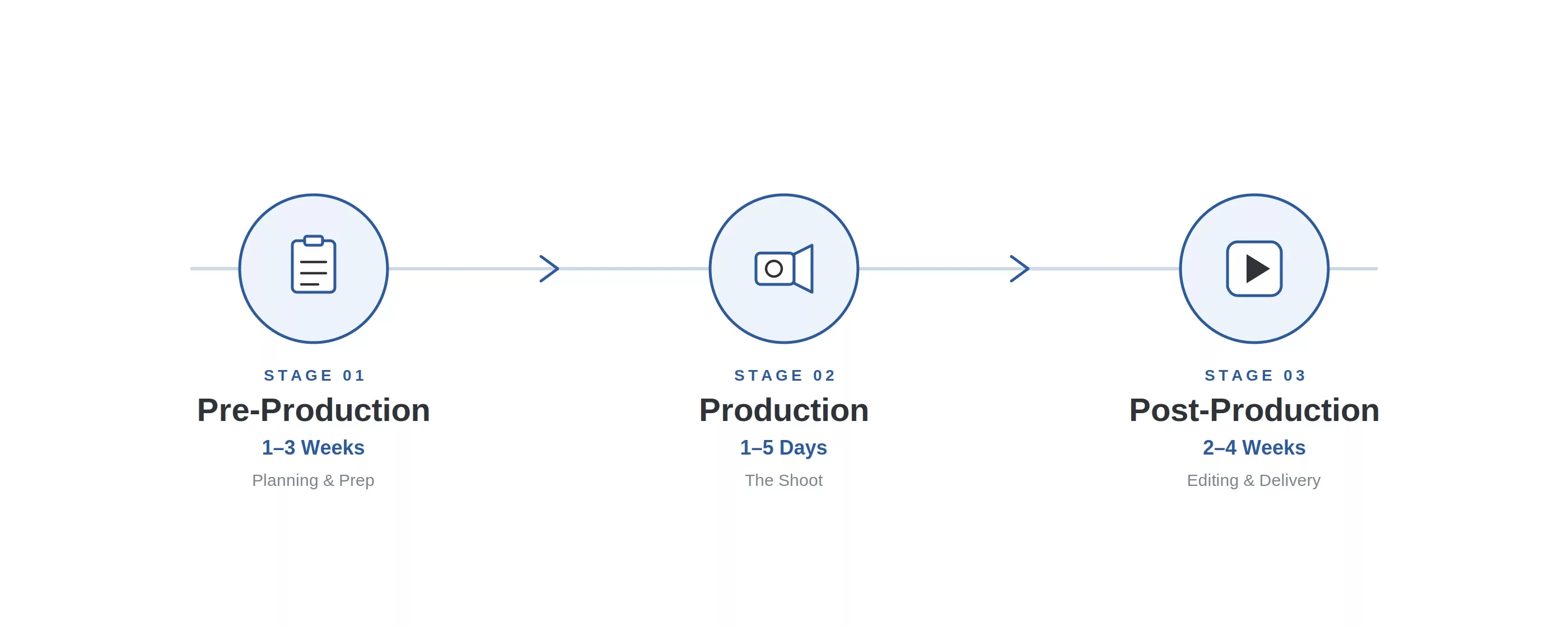
Pre-Production: 1 to 3 Weeks
Pre-production is where the timeline actually gets decided, even though nothing has been filmed yet. This phase covers the discovery call, the creative brief, scripting, storyboarding, location scouting, talent booking, and building a shot list detailed enough that shoot day runs on schedule instead of by improvisation.
In our corporate video production process, this starts with a strategy conversation rather than a sales pitch, because everything downstream depends on a clear brief: who the video is for, what it needs to accomplish, and how it will be distributed once it is finished. A simple testimonial video might need only a few days of prep. A multi-location brand film with executive interviews and a full crew can reasonably take two to three weeks of planning before anyone picks up a camera. Skipping this phase to save a few days almost always costs more time later, usually during the shoot or in post-production when a missing shot has to be worked around instead of captured.
Production: 1 to 5 Days (This Is the Actual Shoot)
This is the phase people mean when they ask how long it takes to shoot a video, and for most business video, the honest answer is that it is shorter than people expect. A single-location testimonial or executive interview typically wraps in half a day. A corporate brand film or commercial usually needs one to two shoot days. Documentary-style projects with multiple interview subjects or locations can run three to five days, sometimes spread across separate visits rather than back to back.
The shoot itself carries the full cost of the crew, equipment, and location for every day it runs, which is why a tightly planned single shoot day is usually the most efficient path, both for budget and for timeline. Multi-day shoots are sometimes unavoidable, particularly for documentary work or productions covering more than one site, but they are the exception rather than the default for corporate video.
Post-Production: 2 to 4 Weeks
Post-production is almost always the longest phase of a video production timeline, and it is the one clients most often underestimate. Editing, color grading, sound design, motion graphics, and music licensing all happen here, along with the client review and revision rounds that determine the final delivery date more than any other single factor.
A straightforward edit of interview footage with supporting B-roll and titles moves faster than a production with heavy motion graphics or a multi-format deliverable list. The biggest variable inside post-production is not the editing itself but how quickly feedback comes back. A client who consolidates notes into a single, clear round of revisions can shave a full week off delivery compared to a project with several scattered rounds of small changes.
How Long Does It Take to Shoot a Film?
This is where the corporate video timeline and the feature film timeline diverge sharply, and it explains a lot of the confusion when people search this question. For a Hollywood or independent feature film, principal photography, the actual filming stage, typically runs 30 to 90 days. A straightforward drama might wrap in a month, while an effects-heavy blockbuster can shoot for well over 100 days, not counting additional second-unit work. True low-budget indie features sometimes compress that schedule to 10 to 20 days by shooting with a small crew and a tightly locked script.
That filming window is only one piece of a much longer process. Once development, pre-production, post-production, and distribution are included, a studio feature typically spans one to two years from greenlight to release, and effects-driven franchise films can stretch to three or four years.
A business video built with the same cinematic techniques, thoughtful lighting, real locations, a director who understands performance, does not carry that overhead. Brand films and commercial-style videos are shot in a day or two precisely because the production is scoped tightly around a defined message rather than a two-hour narrative. The cinematic look does not require the feature film schedule.
Video Production Timeline by Project Type
Different video formats carry different timelines, and knowing which category a project falls into is the fastest way to set a realistic expectation before a single email goes out.
Project Type | Typical Shoot Time | Typical Total Timeline |
|---|---|---|
Testimonial or case study video | Half day | 1 to 2 weeks |
Product demo or explainer video | 1 day | 2 to 3 weeks |
Corporate brand film | 1 to 3 days | 3 to 6 weeks |
Commercial | 1 to 2 days | 2 to 5 weeks |
Training or onboarding video | 1 to 2 days | 2 to 4 weeks |
Documentary-style brand story | 2 to 5 days (often multiple visits) | 4 to 8 weeks |
Event video coverage | Length of the event | 1 to 2 weeks after the event |
Executive messaging / leadership video | Half day to 1 day | 1 to 2 weeks |
These ranges assume a single primary location and a normal revision process. Multiple locations, custom animation, or a long approval chain with several stakeholders will push any of these toward the longer end.
What Actually Slows a Video Production Timeline Down
In our experience, the single biggest timeline risk is not the filming, it is everything around it. Slow or scattered feedback during revision rounds is the most common delay we see: a project can sit in post-production for an extra week simply waiting on a consolidated round of notes from a client-side team. Talent and stakeholder availability is the next most common issue, particularly for executive interviews where a CEO’s calendar controls the shoot date more than anything the production team can plan around.
Multi-location productions add real time, both for logistics and for the extra editing that comes with cutting footage from more than one place into a cohesive story. And scope changes mid-project, adding a deliverable format that was not part of the original brief, almost always add days that were not built into the original estimate. None of these are dealbreakers, but they are the reasons a three-week project sometimes becomes a five-week project.
How to Keep Your Timeline on Track
A few habits consistently keep video production timelines close to the original estimate. Naming a single decision-maker on the client side prevents feedback from arriving in conflicting rounds from different people. Locking location and talent availability early, ideally during the first week of pre-production, removes the most common scheduling bottleneck before it can push the shoot date. Defining every deliverable format up front, the full-length cut, the social edits, the internal version, keeps post-production scoped correctly instead of expanding after the primary edit is already approved.
We build every corporate video production timeline around these same principles, starting with a clear creative brief so the schedule is realistic from day one rather than adjusted after the fact.
Event Video Timelines Work a Little Differently
Event video production follows a different rhythm than a scheduled studio shoot, because the event itself sets the production date and there are no second takes. Pre-production is planning-heavy: reviewing the run of show, mapping camera positions to every session and key moment, and coordinating with the venue and any AV team well before the first guest arrives. The shoot happens in a single, fixed window, the length of the event itself, with no flexibility to reschedule around weather or a delayed flight.
Post-production typically wraps in one to two weeks for most events, which is fast by video production standards, because event recap content loses value quickly once the moment has passed. A highlight reel that goes out while attendees are still talking about the event performs differently than one that arrives a month later.
A realistic video production timeline is not about rushing every phase. It is about knowing which phase actually needs the time, protecting pre-production so the shoot runs smoothly, and building in a clear feedback process so post-production does not stretch longer than it has to. If you have a launch date, an event, or a campaign deadline driving your timeline, the earlier that date is on our calendar, the more room we have to plan properly around it.
Frequently Asked Questions
How long does it take to shoot a film?
Principal photography for a feature film typically takes 30 to 90 days, depending on budget and complexity. Effects-heavy blockbusters can run past 100 days, while ultra-low-budget indie features sometimes wrap in under two weeks with a small crew and a tightly locked script.
How long does it take to produce a corporate video from start to finish?
Most corporate videos take 3 to 6 weeks from kickoff to final delivery: roughly one to two weeks of pre-production, one to two shoot days, and two to four weeks of post-production and revisions.
How many days does a typical business video shoot take?
Most business videos, including testimonials, brand films, and commercials, shoot in a single day. More involved productions with multiple locations, a large cast, or extensive B-roll may need two to three days.
Can a video production timeline be rushed?
Yes, within limits. A rush turnaround usually means fewer revision rounds and a rush fee, and it puts more pressure on pre-production being airtight, since there is little room left to fix problems during editing.
What is the longest phase of a video production timeline?
Post-production is almost always the longest phase. Editing, color grading, sound design, and client revision rounds take more time than most people expect, even when the shoot itself only takes a day.
How far in advance should I book a video production company?
For a project with a hard deadline, a product launch, an event, or a campaign date, book 6 to 8 weeks out. For flexible projects, 3 to 4 weeks of lead time is usually enough to secure a crew and start pre-production properly.
Start Your Project
Ready to Bring Your Story to Video?
Book a free strategy call, and we'll help you figure out which type of video will deliver the best ROI for your business.