
How to Build a 2027 Video Budget That Actually Gets Approved

Somewhere on your desk right now, next year's budget spreadsheet has a line item called video with a number typed into it, and you're not entirely sure how you got there. That's normal. Video is one of the hardest lines to defend in any marketing budget review, because finance wants a formula and most video costs don't come with one.
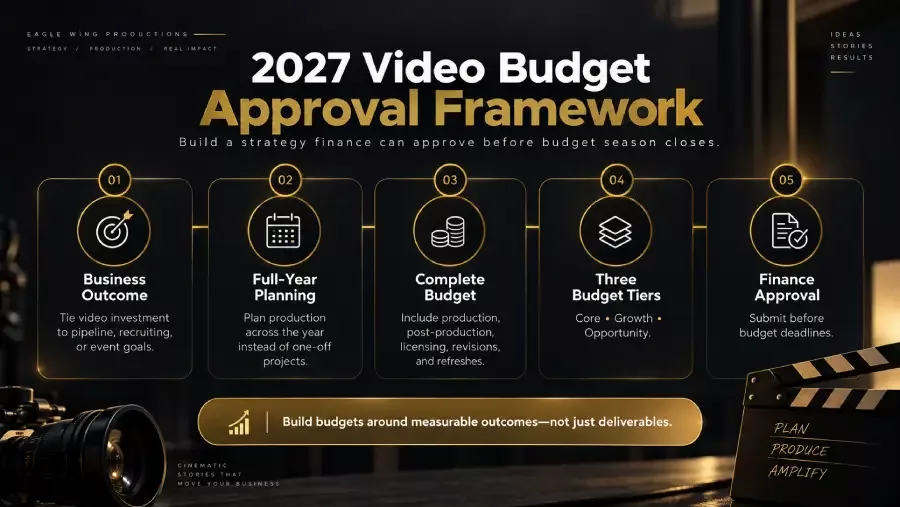
Here's the direct answer. A 2027 video budget gets approved when it's tied to a business outcome finance already tracks, built from a full year of planned production instead of one-off projects, and submitted before the budget cycle closes rather than mid-quarter as an emergency ask. Everything below breaks down how to build that number and get it signed off the first time you ask.
According to Wyzowl's State of Video Marketing report, 92% of marketers plan to spend the same or more on video year over year, so the real fight in most companies isn't whether video gets funded. It's whether your specific request survives the review.
Why Most Video Budget Requests Get Cut Before They're Read
Before building the number, it helps to know why last year's ask, if you made one, didn't land, or why the video line always seems to be the first one trimmed when budgets tighten.
Four patterns show up over and over in the requests that get rejected.
The number is a guess. A round figure like fifty thousand dollars for video, with no breakdown, reads as padding to a finance team that's used to seeing line items justified.
It's tied to deliverables, not outcomes. Six videos tells a CFO nothing about what those videos are supposed to do for the business.
It arrives after the budget is already set. Requests submitted mid-quarter compete for whatever discretionary funds are left, and leftover funds are the first thing that gets frozen when the company misses a number.
It looks like scope creep. If last year's video spend crept up project by project without ever being formally re-budgeted, this year's ask reads as more of the same, not a plan.
Fix the first three of these and the fourth mostly fixes itself, because a clear annual plan is the opposite of scope creep.
Anchor the Number to a Business Outcome, Not a Deliverable List

Finance doesn't fund video. Finance funds pipeline, recruiting, event attendance, or whatever metric the business already reports on. The single biggest shift that gets a video budget approved is reframing the ask around one of those numbers instead of a list of deliverables.
If the goal is sales enablement, tie the budget to the deal cycle: how many prospects see a demo video before a call, and what that does to close rate. If it's recruiting, tie it to applicant volume or time to fill. If it's an annual event, tie it to registrations, or to the content library that event footage becomes for the next twelve months.
That reframing takes real planning, not just better wording, which is where a formal video consulting engagement earns its cost before a single dollar goes to production. Working through the outcome, the audience, and the format mix with a consultant before the number goes to finance means you're walking into the review with a plan finance can attach to a metric they already track, not a wish list.
What Actually Belongs in the Line Item
The number people bring to budget season is almost always the shoot day rate, and almost never the full cost of getting a finished, distributed video. Four categories consistently get left out, and leaving them out is why an approved budget still runs over by fall.
Post-production - the editing, color, sound, and revision rounds that happen after the camera stops rolling, and on most projects it takes longer and costs more than the shoot itself.
Distribution and usage rights - paid promotion behind the video, platform-specific reformatting for social, and licensing if the project uses stock music, footage, or talent whose usage window expires after a set period.
Revisions beyond the first round - should be built into the estimate up front, since unplanned revision requests are one of the most common places a project quietly exceeds budget.
Refresh and update costs - a testimonial video or a stat-heavy explainer has a shelf life. Budgeting a small refresh line partway through the year keeps the asset current instead of letting it go stale and unused.
Build these four into the number from the start, and the budget that gets approved in January is much closer to the number you're still working with in December.
Build in Three Tiers, Not One Number

A single lump-sum ask is easy to reject outright. A tiered budget gives finance options, which is a very different conversation than a yes or no.
Structure the annual ask into three tiers.
The core tier covers the recurring content a business needs regardless of campaign activity: a handful of testimonial videos, an updated brand or explainer piece, and ongoing social cutdowns from existing footage.
The growth tier adds campaign-specific production tied to a launch, an event, or a seasonal push, sized to whatever the marketing calendar already has planned.
The opportunity tier is a smaller reserve, not a specific project, held for the mid-year request that always comes up: a trade show added late, a leadership change that needs a new bio video, a competitor move that needs a fast response.
Presenting three tiers instead of one number does two things. It shows finance you've thought about priority, not just total spend, and it gives them room to approve the core and growth tiers in full while trimming or holding the opportunity tier, rather than cutting the whole request by a flat percentage because the total felt too big to approve as written. If you want real dollar ranges to plug into each tier, our 2026 pricing breakdown is a good starting point.
Time the Ask to Your Fiscal Calendar
Most video budgets that get approved on the first pass aren't better written, they're just earlier. Finance teams typically build the following year's forecast in the third quarter, which means by the time most marketing teams start thinking about next year's video plan in November or December, the discretionary pool is already allocated to whoever asked first.
Submit the annual video ask alongside the broader marketing budget request, not after it, and time it to your company's specific planning cycle rather than the calendar year. If your fiscal year starts in July, the video budget conversation needs to start in April or May, not January.
If you're building this for the first time and don't know your organization's actual budget cycle, that's worth finding out before drafting a single number. Ask finance or your VP directly when department budgets are due. The answer is rarely a secret, it's just rarely asked, and knowing the real deadline is what separates a request that gets full consideration from one that arrives after the decisions are already made.
How to Present It So Finance Says Yes
The framing matters as much as the number. A few patterns consistently move a request from maybe to approved.
Show the outcome first and the deliverables second. Open the request with the metric the budget supports, then list what gets produced to hit it, not the reverse.
Bring a comparable, not just a projection. If a past video project drove a measurable result, whether that's applicant volume, demo requests, or event registration, lead with that real number instead of a hypothetical one.
Don't ask for the bare minimum. A budget that's cut to the bone gets spent on the cheapest available option, which is usually the one that needs to be redone within the year, and then you're back in front of finance asking for money you already spent once. In our experience, a request with a small, honest buffer built in survives negotiation better than one that has no room to give.
Attach a simple one-page summary, not a full deck. Finance teams reviewing dozens of department requests respond better to a clear one-pager with the ask, the outcome, and the tier breakdown than to a long strategy presentation. Save the deeper strategy conversation for after the number is approved.
Loop In a Production Partner Before the Number Goes to Finance
The teams that get their video budget approved on the first pass almost always built the number with input from the people who'll actually produce the work, not in isolation. A production partner can tell you, before the request goes anywhere, whether the scope you're imagining matches the budget you're about to ask for, which prevents the mid-year gap between approved and enough.
If the plan spans several formats across the year: brand video, testimonials, event coverage, and social cutdowns, it helps to build that as one integrated video marketing plan rather than pricing each format separately, since one team working from a shared strategy typically produces more usable content per dollar than five separate one-off projects handled piecemeal. That's also why it pays to start with strategy before you touch a budget number the format mix should come first, and the number should follow it, not the other way around.
Start that conversation before budget season closes, not after the number is already locked. It's much easier to adjust a proposed number than an approved one.
Final Thoughts
Budget season moves fast, and the video line is usually the one nobody wants to defend first. Build the number from outcomes, tiers, and a real fiscal calendar instead of a round guess, and it stops being the line that gets cut and starts being the line finance already expects to see.
If you're heading into 2027 planning and want a second set of eyes on the number before it goes up the chain, that's exactly what a video consulting conversation is for.
Frequently Asked Questions About Video Budget Planning
How much should a company budget for video marketing in 2027?+
There's no single number that applies across industries, but a useful starting benchmark is Wyzowl's finding that most marketers put a third or less of their total marketing budget toward video. Start from your existing marketing budget and work backward from an outcome, not from an industry average that may not fit your company's size.
When should I submit my video budget for approval?+
Submit it alongside your broader marketing budget request, during the quarter your finance team builds next year's forecast, which for most companies is the third quarter for a January fiscal year start. Waiting until the new year begins means competing for whatever discretionary funds are left.
Should video be budgeted by project or for the full year?+
Budget it for the full year in tiers whenever possible. Project-by-project budgeting tends to cost more overall, since each request gets priced and negotiated separately instead of benefiting from one team planning the whole year's content at once.
What's the most common reason a video budget request gets rejected?+
It's usually because the request is tied to a list of deliverables instead of a business outcome finance already tracks, like pipeline, recruiting, or event attendance. A number without a metric attached reads as discretionary spend, which is the first thing cut when budgets tighten.
What costs do companies most often forget to include in a video budget?+
Post-production time, usage rights and licensing, and a buffer for revisions beyond the first round are the three most commonly missed line items, and all three tend to surface as unplanned costs later in the year if they're not built in up front.
Do smaller companies need a formal video budget process?
Yes, arguably more than larger ones, since a small marketing budget has less room to absorb an unplanned mid-year video cost. A simple two-tier version of the framework above, core content plus a small opportunity reserve, is usually enough for a smaller team.
Start Your Project
Ready to Bring Your Story to Video?
Book a free strategy call, and we'll help you figure out which type of video will deliver the best ROI for your business.