Behind the Scenes: What a Full-Day Commercial Video Shoot Looks Like in Utah
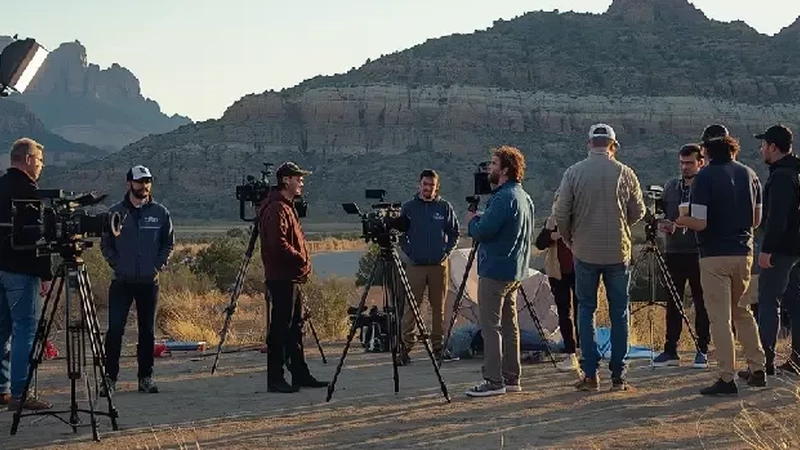
A commercial video shoot in Utah typically runs 10 to 14 hours from crew call to wrap, divided into pre-light, setup, principal photography, and breakdown phases. Understanding each phase helps clients manage their time on set, provide useful feedback in real time, and avoid the costly mistakes that come from last-minute decisions made under production pressure.
The average professional commercial video shoot involves 8 to 15 crew members and requires 3 to 5 weeks of pre-production before a single camera rolls.
Production Hub Industry Survey, 2023
The Full-Day Shoot Schedule: A Timeline
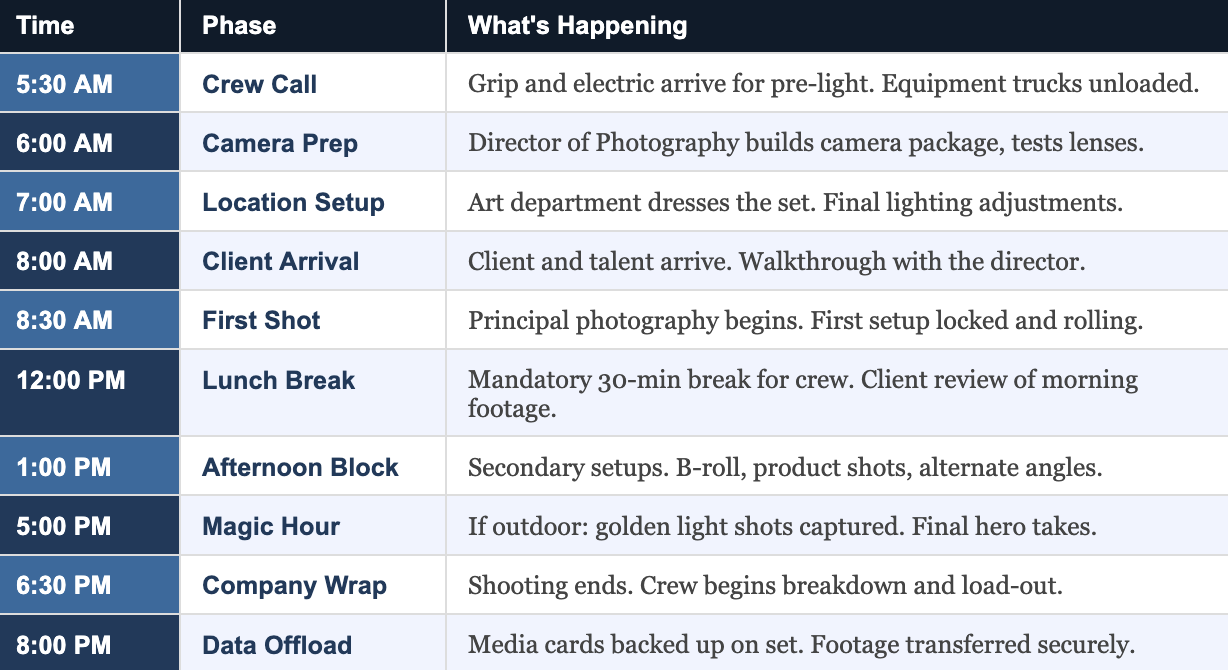
Before we go deep on each phase, here is a high-level look at how a standard single-day commercial shoot in Utah is structured. Times are approximate and vary by project scope, location, and season.
Pre-Light and Crew Call: Before You Arrive, the Work Has Already Started
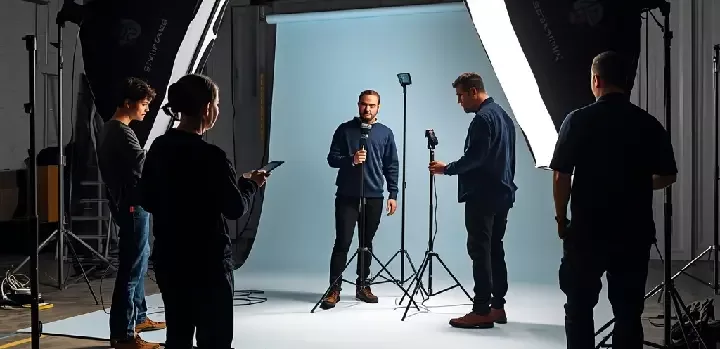
The client almost never sees this phase, but it is one of the most labor-intensive parts of the entire shoot day. Grip and electric crew — the team responsible for rigging lights, managing power distribution, and building out the physical infrastructure of the set — typically arrive two to three hours before the first camera roll. On a Salt Lake City interior shoot, that often means a 5:30 or 6:00 AM crew call.
During pre-light, the gaffer (chief lighting technician) executes the lighting plan developed during pre-production in collaboration with the director of photography. On Utah shoots — particularly in the winter months when natural light is limited and interior temperatures are a factor — this phase can be the longest of the day. Running power to multiple rooms, balancing artificial light with window light in a Wasatch Front office building, or rigging overhead fixtures in an industrial space all take time that clients rarely account for in their mental picture of the shoot.
The camera department uses this window to prep the camera package: testing lenses, calibrating focus marks, charging batteries, and formatting media cards. A director of photography who arrives to find a perfectly pre-lit set can move significantly faster through the shot list, which directly affects how much you get done before wrap.
What clients can do during this phase:
Review the shot list and confirm priorities with the producer
Confirm talent call times and handle any last-minute wardrobe or makeup logistics
Stay out of the way — the crew needs unobstructed space to work efficiently
The Morning Block: Principal Photography and the First Setup
Principal photography - the actual shooting of scripted or planned content - typically begins between 8:00 and 9:00 AM. The first setup is always the slowest. Even with meticulous pre-production, the transition from a plan on paper to live action on a real set involves adjustments: a light needs to move six inches, a background element is distracting, the talent's eyeline is slightly off. These are not signs of a disorganized shoot. They are the normal friction of translating a vision into reality.
A professional director will work through the first setup methodically, establish the look and tone for the day, and then move progressively faster through subsequent setups as the crew finds its rhythm. On Utah commercial shoots - whether in a tech office in Sandy, a restaurant in the Avenues, or a retail environment in downtown Salt Lake City - the morning block is typically used for the most technically demanding setups: hero product shots, scripted dialogue scenes, or anything requiring precise lighting control.
This is where client presence and responsiveness matters most. When a director or producer needs a quick decision on a performance take, a product arrangement, or a background detail, a delayed answer costs real time. Come to set prepared to make decisions, not to deliberate.
In our experience working with Utah brands, the clients who get the most out of their shoot day are the ones who come prepared with a clear priority list and the authority to make decisions on the spot. Every 15 minutes of on-set deliberation is 15 minutes of production time you will not get back. |
Lunch and the Mid-Day Review: The Most Underrated Part of the Day
Federal labor rules for film and video crews require a meal break after no more than six hours of continuous work. On most commercial shoots in Utah, this translates to a 30-minute lunch break around midday. What happens during that half hour matters more than most clients realize.
Smart producers use the lunch break as a structured checkpoint: the director and DP review the morning's footage, assess the shot list against what has been completed, and make any necessary adjustments to the afternoon schedule. If the morning ran long on a complex setup, something in the afternoon needs to be compressed or cut. If the morning ran ahead of schedule, there may be room to add a setup the team did not think was achievable. This recalibration is critical.
As a client, the lunch break is your best window to review selects from the morning, ask questions without interrupting production, and get an honest read on how the day is tracking against the original plan. A good producer will proactively bring you this information. If they do not, ask.
Questions to ask at the mid-day break:
Are we on track with the shot list? What is still outstanding?
Is there anything from the morning we should go back and capture?
Are there any setups this afternoon that are at risk of not being completed?
The Afternoon Block: B-Roll, Product Shots, and Flexibility
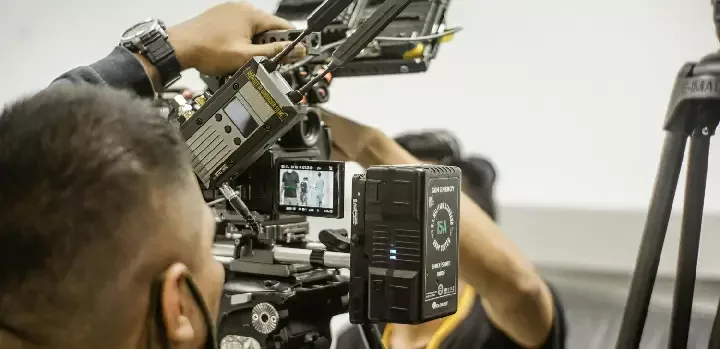
The afternoon block of a commercial shoot is where the visual texture of the final video gets built. Principal photography — the scripted, hero content — is usually complete or near-complete by early afternoon. What remains is B-roll: the supporting footage that editors use to cut away from the main subject, establish the environment, and add visual variety to the final piece.
On a commercial shoot in Utah, this might mean wide establishing shots of the Salt Lake City skyline from a rooftop, close-up product detail shots on a table-top setup, footage of employees working in their actual environment, or cutaways of hands interacting with equipment or interfaces. B-roll is often underestimated by clients but overvalued by editors — it is the footage that makes a video feel complete and professionally produced rather than like a talking-head recording.
The afternoon is also where flexibility pays dividends. Utah's light changes dramatically through the day, particularly in winter when the sun drops behind the Wasatch Range earlier than expected. A crew that has moved efficiently through the morning creates space in the afternoon to respond to those conditions, capture an unexpected opportunity, or reshoot something that did not work in the morning.
Videos that include a mix of scripted content and B-roll footage generate 2x more engagement than single-angle productions, according to internal platform data from Wistia's 2023 Video Benchmarks Report. Wistia Video Benchmarks Report, 2023 |
Utah-Specific Considerations That Affect Every Shoot Day
Filming in Utah introduces a set of practical variables that out-of-state crews consistently underestimate. A local production team navigates these as a matter of course. An unfamiliar crew encounters them as problems.
Weather and light
Utah's high-desert climate means dramatic weather shifts, especially along the Wasatch Front. A Salt Lake City exterior shoot planned for March can face sun, snow, and cloud cover within the same four-hour block. Experienced local crews build contingency plans into their shot lists, know which setups can flex to overcast conditions, and have relationships with covered backup locations. This is not optional planning — it is standard operating procedure.
Altitude and physical exertion
Salt Lake City sits at 4,226 feet above sea level. Park City, a common shoot location for outdoor and lifestyle brands, sits at over 7,000 feet. Crew members unaccustomed to altitude can experience reduced stamina, headaches, and slower decision-making — all of which affect production efficiency. Local crews are acclimated. Traveling crews are not, at least not on day one.
Permits and location access
Filming on public property in Salt Lake City requires permits managed through the Salt Lake City Film Office. Requirements vary by location, crew size, and equipment footprint. A local production company handles this as a standard part of pre-production. An out-of-state team may not even know to ask until they arrive at a location and are turned away.
Seasonal light windows
Utah's summer days offer extended golden-hour windows that experienced outdoor brand and lifestyle videographers plan around. Winter days compress dramatically — golden hour in January in Salt Lake City can last as little as 20 minutes. A local crew builds the shot schedule around these realities. A non-local crew often does not.
If you are planning a commercial shoot in Salt Lake City or anywhere across Utah, working with a crew that already knows the terrain, the light, and the permitting process is not a luxury. It is a production efficiency decision. -> eaglewingproductions.com/request-a-quote |
Wrap, Data Backup, and the Handoff to Post-Production
"Company wrap" is the term used when principal photography ends and the crew begins breaking down the set. On a standard commercial shoot in Utah, wrap typically begins between 6:00 and 7:00 PM, though this varies significantly by project scope. Breakdown involves striking lights, coiling cable, packing cameras, loading equipment trucks, and restoring the location to its original condition — a process that can take two to three hours for a large setup.
Simultaneous to physical breakdown, the most critical technical process of the entire day happens: data offload. Media cards from all cameras are copied to at least two separate drives on set, checksummed for verification, and labeled by camera, scene, and time code. On professional Utah shoots, this process is handled by a dedicated data wrangler or, on smaller crews, by the assistant camera. The footage that leaves the set on those drives is irreplaceable. A crew that treats this step casually is a crew worth being concerned about.
Once footage is secured, the project transitions to post-production: editing, color grading, sound design, and delivery. The editorial team uses the shoot day's footage, combined with any pre-approved graphics, music, or voice-over, to build the first cut — which typically arrives within two to three weeks on a standard commercial project.
What clients should ask at wrap:
Is all footage backed up to at least two drives?
What is the timeline for receiving the first rough cut?
Are there any issues from today the editor needs to know about?
What is the revision process from here?
See What Your Shoot Day Could Look Like
A well-run commercial video shoot is not chaos managed in real time. It is a structured, pre-planned process executed by a crew that knows exactly what it is doing from the moment the first equipment case is opened. At Eagle Wing Productions, every shoot day we run in Utah — whether in Salt Lake City, Park City, Provo, or Ogden — is built on pre-production work that makes production efficient and post-production predictable.
If you are early in your planning process and want to understand what a shoot would actually involve for your specific project, we are happy to walk you through it. No commitment required.
Ready to see what your shoot day could look like? Tell us about your project and get a clear production plan and itemized quote within 48 hours. We work with businesses across the Wasatch Front and throughout Utah. |
Frequently Asked Questions
How long does a commercial video shoot take in Utah?+
Most single-location commercial shoots run 10 to 14 hours from crew call to wrap, including setup, principal photography, and breakdown. Multi-location shoots or projects with complex setups may require two shoot days. The honest answer depends on your shot list, location logistics, and how efficiently pre-production has been executed — which is why the pre-production phase is as important as the shoot day itself.
How many people are on a professional video production crew?+
A standard commercial shoot crew in Salt Lake City typically includes 8 to 15 people: a director, director of photography, gaffer, grip, audio engineer, production assistant, and depending on the project, an art director, hair and makeup artist, and on-camera talent. Smaller content-focused shoots can run with a crew of four to six. Crew size directly affects both cost and production capacity — a larger crew moves faster through a complex shot list.
What should I as the client bring to the shoot day?+
Come with your priority list clearly ranked, the authority to make decisions without needing to call an approval chain, any product or brand materials that need to be on camera, and comfortable clothes for a long day. Review the shot list in advance so you are not reading it for the first time on set. The more prepared you are as a client, the more efficiently the crew can work.
What happens if the weather is bad on shoot day in Utah?+
Experienced Utah production teams build weather contingencies into every outdoor shoot plan. This includes identified backup interior locations, a flexible shot-order that can be resequenced around conditions, and clear communication protocols if a reschedule becomes necessary. Weather-related reschedules are a standard part of the production contract and should be addressed explicitly before you sign.
How soon after the shoot day will I see the first cut?+
For a standard commercial video project, the first rough cut typically arrives within two to three weeks of wrap. More complex projects with multiple deliverables, extensive motion graphics, or original music composition can take four to six weeks. A professional production company will give you a post-production schedule in writing before the shoot, not after.
What is B-roll and why does it matter for my commercial?+
B-roll is the supporting footage that editors intercut with your primary content — establishing shots, close-up details, environmental footage, and cutaways. It is what makes a commercial feel polished and visually dynamic rather than like a static recording. A well-planned shoot day allocates dedicated time for B-roll capture, usually in the afternoon block. Clients who skip or compress B-roll to save time consistently regret it in the edit.
Start Your Project
Ready to Bring Your Story to Video?
Book a free strategy call, and we'll help you figure out which type of video will deliver the best ROI for your business.